
Playing football was one of the few things I was good at in high school. Through sheer luck, the high school I attended in suburban Northern Virginia had a good football program. In the four years of my high school career, we were either in or just missed making the regional playoffs. Yet, as good as we were, there was one team in our district that was even better, and they had won the State Championship to prove it: the T.C. Williams Titans.
The Disney movie Remember the Titans tells the story of the team’s 1971 season, set against the backdrop of desegregation and the struggle to integrate black and white students as two smaller high schools—one with mostly black students and one with primarily white students —consolidated to form T.C. Williams. A central dramatic element of the movie was the selection of assistant coach Herman Boone, a black man, to be the team’s head coach instead of his more experienced peer at the time, assistant coach Bill Yoast, a white man.
Today, the school administration would probably have been accused of being “woke,” and Coach Boone definitely would have been considered a “DEI hire”. Speaking of, you may have noticed a pattern; these terms are applied in a tongue-in-cheek way to any person or situation that doesn’t end up favoring white people, predominantly white men.
Despite the sarcasm, when “woke” or “DEI” are used, there is usually a real backstory behind the issue that doesn’t get told, and that’s true here.
Despite the City of Alexandria being within sight of Washington, D.C., segregation, violence against black people, and systemic racial discrimination were very real. People in the communities around the new high school had experienced the beating and murder of several black youths, and there was a perception in parts of the community that the police and white people involved were not adequately held accountable for the incidents.
Though I couldn’t find much about it in the written records or news at the time, it seems reasonable that the city administration hoped Coach Boone’s promotion would signal their desire to make an equitable decision that might ease the fears of at least some student athletes and their families that they received unfair treatment.
Of course, my teammates and I were unaware of this or any other backstory. We just knew that “TC,” as we called them, were probably better than we were, man-to-man, and that we had to play our very best to beat them.
I wonder if TC or the other schools in Northern Virginia would have integrated without Brown v. the Board of Education, federal legislation, and the civil rights movement. Today, those activities would fit under the generic banner of “DEI”, which some are now trying to eliminate.
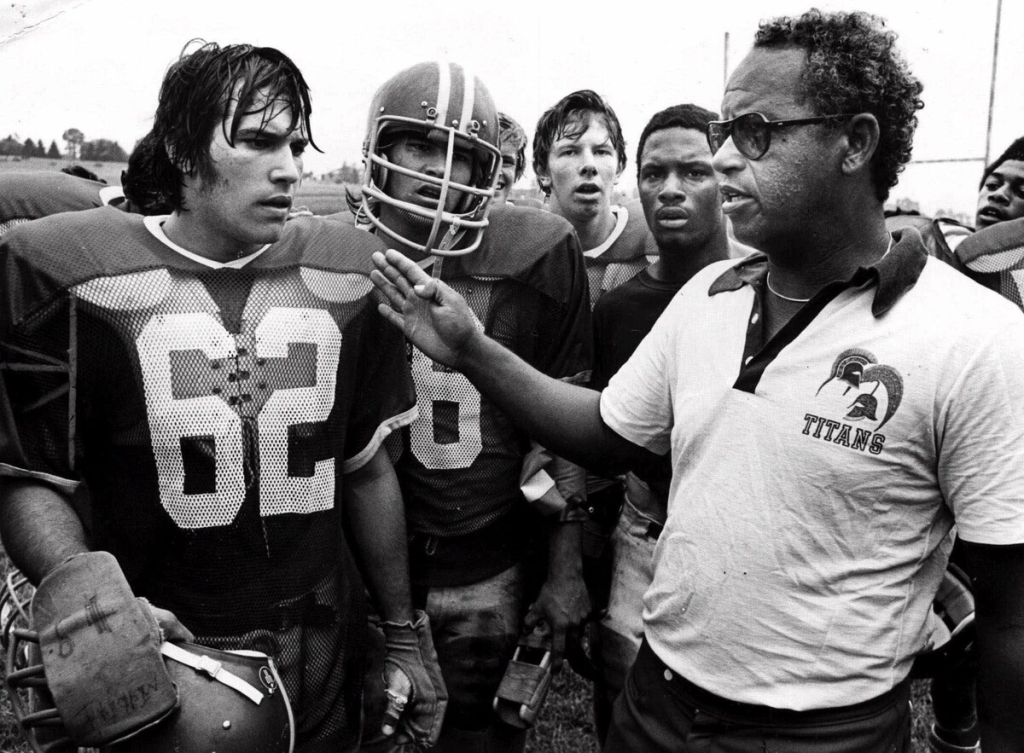
Our coaches and teachers would have been labeled as “woke”. They never joked or commented about T.C. Williams being a majority black school compared to our majority white school, nor did they ever make excuses when we lost. I think they knew enough to not claim they were “Color blind” – a hollow and senseless claim “unwoke” white people sometimes make when defending themselves.[1]
When we don’t personally confront systemic bias, it is normal for us to assume that everyone else experiences the world the same way we do. This dynamic can cause us to miss a lot.
I am astonished at what I either missed or overlooked as a teenage young man. For example, TC’s home games were played on Saturdays, not at night, but in the afternoon. The story I heard was that the student body of TC was violent and dangerous and that they were less likely to commit crimes in the middle of the day.
The school district didn’t have the money to install night lights for night games for TC until 2015. I graduated in 1976, and our high school had lights the whole time. I wonder if TC students felt they missed out by never having a genuine “Friday Night Lights” game that was such an embedded memory of my four-year high school experience.
I missed that TC’s home games were so poorly attended. Many students worked part-time jobs on the weekends.
I missed that. In 8 years of playing little league and high school football, I never had an African American coach or assistant coach, although all the teams I played on had black players. The first black coach I can remember seeing was Coach Boone.
And worst of all, I missed understanding that the violence TC Williams students experienced that prevented them from having home games at night was violence against them, not violence caused by them.
The term “DEI” may be unusable now because of its misrepresentation. But without it, I’m curious: What else will we miss? What process, system, or strategy will help us eliminate systemic bias and discrimination?
This new form of DEI—whatever we call it—will still be crucial in recruiting, training, preparing, and deploying military personnel. Making workplaces attractive for top talent who don’t look like the ruling class will still be an essential competitive element for businesses. Will we notice when the workplaces that covertly embrace DEI dominate the talent war?
What will be the impact on today’s students if we completely ban teaching the real history of the U.S. and the world?
One thing’s certain: Systemic bias, stereotypes, and marginalization won’t go away on their own.
#DEI
#diversity
#equity
#Inclusionmatters
#beawake
#realhistory
[1] The goal has never been to be “color-blind: which would be to pretend we don’t notice difference in skin color. The goal has been to be “color aware,” which means to see color but to not allow our pre-conceived notions about it to influence our partnerships.